How Are Genetic Disorders Passed from Parents to Children?
Gusti Ayu Tita P
22 September 2026
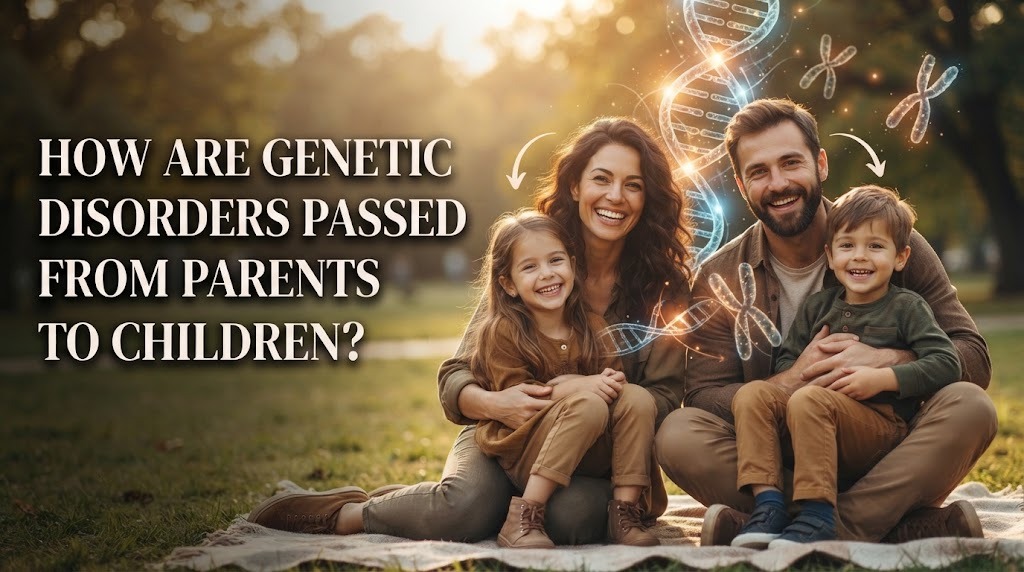
Genetic disorders can sometimes be passed from parents to children through changes in genes or chromosomes. Every child receives genetic material from both biological parents, which helps determine how the body develops and functions. If a parent carries a disease-causing genetic variant, there may be a possibility that it will be inherited by a child. However, the chance of inheritance depends on the specific condition and its genetic inheritance pattern. Understanding how genetic disorders are inherited can help families recognize potential risks and seek appropriate medical advice.
HOW ARE GENES PASSED FROM PARENTS TO CHILDREN?
Genes are sections of DNA that contain instructions for making proteins and supporting important functions in the body. A child normally receives one copy of each gene from each biological parent. This means that children inherit approximately half of their nuclear DNA from their mother and half from their father. The combination of genetic material creates an individual's unique biological characteristics.
When a parent carries a disease-causing variant, that variant may be passed to a child during reproduction. Whether the child develops a disorder depends on factors such as the type of variant and whether one or both copies of a gene are affected. Some genetic variants can cause a condition when only one copy is altered, while others require changes in both copies.
WHAT IS AUTOSOMAL DOMINANT INHERITANCE?
In autosomal dominant inheritance, a disease-causing variant in just one copy of a particular gene can be enough to cause a genetic disorder. A parent with the condition may have one altered copy and one unaffected copy of the gene. For many autosomal dominant conditions, each child has a 50 percent chance of inheriting the altered copy when one parent is heterozygous.
Examples of conditions that can follow an autosomal dominant pattern include Huntington disease and some forms of familial hypercholesterolemia. However, inheritance patterns can be more complicated in certain conditions. Some people who inherit a genetic variant may have different symptoms or severity from other affected family members. Medical genetics professionals can provide more specific information about individual conditions.
WHAT IS AUTOSOMAL RECESSIVE INHERITANCE?
Autosomal recessive inheritance generally occurs when a child inherits disease-causing variants in both copies of a particular gene. Parents who carry only one altered copy may not have symptoms and are often described as carriers. If both parents are carriers of the same recessive condition, each pregnancy typically has a 25 percent chance of producing a child affected by the condition, a 50 percent chance of producing a carrier, and a 25 percent chance of inheriting neither altered copy.
Conditions such as cystic fibrosis and sickle cell disease can follow autosomal recessive inheritance patterns. Because carriers may have no noticeable symptoms, they may not know that they carry a particular genetic variant. This explains why some genetic disorders can occur in a family without a previous diagnosis. Genetic testing can sometimes help identify carrier status when there is a known family risk.
HOW DO X LINKED AND MITOCHONDRIAL CONDITIONS DIFFER?
Some genetic disorders are associated with genes located on the X chromosome. These conditions are known as X-linked disorders and can have different inheritance patterns in males and females because they typically have different numbers of X chromosomes. For example, a male who inherits a disease-causing variant on his single X chromosome may be more likely to show symptoms for certain X-linked recessive conditions.
Mitochondrial inheritance is different because mitochondrial DNA is generally transmitted through the egg cell. As a result, mothers can pass mitochondrial genetic changes to their children, while fathers generally do not transmit mitochondrial DNA to their children. The effects of mitochondrial disorders can vary widely depending on the specific genetic change and the proportion of affected mitochondria in cells.
CAN A CHILD HAVE A GENETIC DISORDER WITHOUT A FAMILY HISTORY?
Yes, a genetic disorder can sometimes appear even when there is no known family history of the condition. A new genetic change, often called a de novo variant, can occur in an egg, sperm, or early embryo. If this new change affects an important gene, it may contribute to a genetic disorder in the child.
Family history can also appear negative because previous relatives may have had mild symptoms, received a different diagnosis, or never received genetic testing. Some conditions may also have variable expression, meaning people with the same genetic condition can experience different symptoms. Therefore, the absence of an obvious family history does not always rule out a genetic cause.
HOW CAN FAMILIES UNDERSTAND THEIR GENETIC RISK?
Families with a known genetic disorder may benefit from genetic counseling. A genetic counselor can review family history, explain the inheritance pattern, and discuss whether genetic testing may be appropriate. Testing can sometimes identify a specific disease-causing variant and provide information about potential risks for relatives or future children.
The exact risk cannot be determined simply by knowing that a genetic disorder exists in a family. It depends on the condition, the specific genetic variant, and the inheritance pattern involved. Genetic testing and professional counseling can provide more accurate information than general assumptions about family history. Healthcare professionals can also explain available reproductive and medical options based on individual circumstances.
CONCLUSION
Genetic disorders can be passed from parents to children through inherited changes in genes or chromosomes. The probability of inheritance varies according to patterns such as autosomal dominant, autosomal recessive, X-linked, and mitochondrial inheritance. Some disorders can also result from new genetic changes and therefore may occur without a known family history. Genetic counseling and genetic testing can help families understand inheritance patterns and potential risks. Learning how genetic inheritance works can support informed healthcare decisions and encourage appropriate medical evaluation when needed.
Tentang Penulis
Gusti Ayu Tita P
Penulis — Universitas STEKOM
Penulis aktif yang berfokus pada isu-isu akademik, teknologi pendidikan, dan pengembangan sumber daya manusia di lingkungan kampus.