How Can Schools Become Environmentally Friendly Adiwiyata Schools?
Gusti Ayu Tita P
15 September 2026
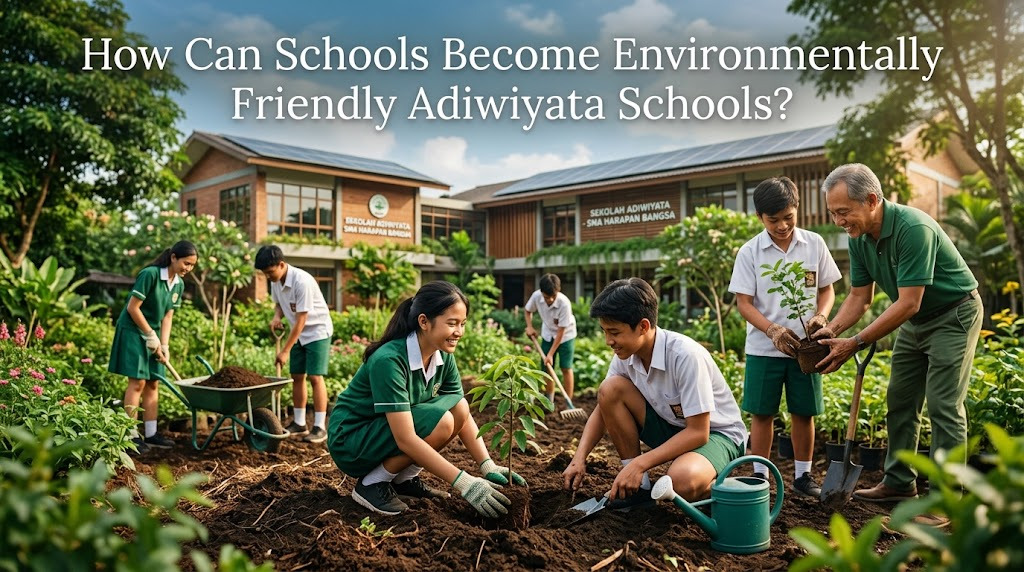
Schools can play an important role in teaching students how to care for the environment. An environmentally friendly school does not only focus on keeping its buildings clean but also develops habits that support environmental sustainability. The Adiwiyata approach encourages the entire school community to participate in environmental protection through education and daily activities. Students can learn about environmental problems while practicing simple solutions in their surroundings. With proper planning and cooperation, schools can gradually develop into Adiwiyata Schools.
UNDERSTANDING THE ADIWIYATA SCHOOL CONCEPT
An Adiwiyata School is an educational institution that builds environmental care into its policies, learning activities, school management, and daily habits. The concept encourages students, teachers, and school staff to take responsibility for maintaining the school environment. Environmental values should not be taught only through theory but also through practical activities. Students can learn by managing waste, caring for plants, saving water, and using energy responsibly. This approach makes environmental education more closely connected to students' everyday experiences.
Becoming an Adiwiyata School is a process that requires continuous commitment. Schools need to identify their environmental conditions and determine which areas need improvement. The program should be adjusted to the school's resources, facilities, and local environmental needs. Every member of the school community should understand their role in supporting the program. With consistent participation, environmental care can become a school culture rather than a temporary project.
CREATING ENVIRONMENTALLY FRIENDLY SCHOOL POLICIES
The first step toward becoming an Adiwiyata School is developing policies that support environmental protection. Schools can establish rules about waste disposal, cleanliness, water conservation, energy use, and the maintenance of green areas. These policies should be clear, realistic, and easy for students and staff to follow. School leaders can also include environmental responsibilities in relevant school programs and activities. Clear policies provide direction for the entire school community.
However, policies alone are not enough to create meaningful change. Students and staff need to understand why the rules are important and how they can apply them. Teachers can explain the purpose of environmental policies during lessons or school activities. School management can also evaluate whether the policies are being followed and identify areas that need improvement. Consistent implementation and evaluation can help environmental policies remain effective over time.
IMPROVING WASTE MANAGEMENT
Proper waste management is one of the most practical ways for schools to develop an environmentally friendly culture. Schools can provide separate containers for different types of waste and teach students how to use them correctly. Reducing unnecessary packaging and encouraging reusable items can also help lower the amount of waste produced. Recyclable materials can be collected and processed through appropriate recycling activities. These practices can make students more aware of how their daily choices affect the environment.
Waste management should involve the entire school community rather than only cleaning staff. Students can participate in environmental campaigns, classroom waste monitoring, or recycling projects. Teachers can explain the differences between organic, recyclable, and residual waste according to the system used by the school. Schools should also ensure that collected waste is handled appropriately after it is separated. Through regular practice, responsible waste management can become a natural part of students' daily routines.
DEVELOPING GREEN AND HEALTHY SCHOOL AREAS
Creating and maintaining green spaces can help make school surroundings more attractive and comfortable. Schools can plant trees, flowers, shrubs, or other suitable vegetation according to the available space and local conditions. Students can participate in gardening and plant-care activities as part of environmental learning. Green areas should be maintained regularly so that they remain healthy and useful. These activities can also give students direct experience in caring for living things.
Greening activities should be planned carefully rather than focusing only on adding more plants. Schools need to consider available land, sunlight, water requirements, and the suitability of plants for the local environment. Gardens can also be used as outdoor learning spaces when conditions allow. Students can observe plant growth and learn about ecosystems through practical activities. In this way, school greening can support both environmental management and educational activities.
SAVING WATER AND ENERGY AT SCHOOL
Another important step is encouraging students and staff to use natural resources responsibly. Schools can promote water conservation by checking taps and pipes, preventing unnecessary water use, and reminding students to close taps after use. Energy conservation can include turning off lights, fans, air conditioners, and electronic devices when they are not needed. Schools can place simple reminders near switches and water facilities to encourage responsible behavior. These actions may seem small, but they can become meaningful when practiced consistently.
Resource conservation also teaches students about the connection between daily habits and environmental sustainability. Teachers can explain why excessive consumption of water and energy can create environmental and economic problems. Students can be encouraged to monitor their own habits and remind their classmates in a positive way. School management can periodically evaluate resource use to identify opportunities for improvement. Efficient use of water and energy is therefore an important part of an environmentally friendly school.
INVOLVING STUDENTS, TEACHERS, AND THE COMMUNITY
A successful Adiwiyata School requires active participation from the whole school community. Students can participate in clean-up activities, gardening, waste management, environmental campaigns, and conservation programs. Teachers can integrate environmental topics into relevant lessons and provide guidance during practical activities. School administrators can provide facilities, develop policies, and coordinate environmental programs. Each group has a different responsibility, but all contribute to the same environmental goals.
Schools can also involve parents and the surrounding community when appropriate. Environmental campaigns can encourage families to continue good habits outside school. Cooperation with community organizations or environmental groups may also provide additional knowledge and support when available. Regular communication can help everyone understand the progress and challenges of the program. Strong cooperation can make environmental practices more sustainable and consistent.
CONCLUSION
Schools can become environmentally friendly Adiwiyata Schools by integrating environmental values into policies, education, school management, and daily activities. Important steps include improving waste management, creating green spaces, conserving water and energy, and providing practical environmental education. The program should involve students, teachers, school staff, parents, and the surrounding community according to their respective roles. Most importantly, environmental practices should be carried out consistently instead of only during special events. With commitment, cooperation, and continuous improvement, schools can develop a strong Adiwiyata School culture that encourages students to protect the environment in their everyday lives.
About the Author
Gusti Ayu Tita P
Author — STEKOM University
An active author focused on academic issues, educational technology, and human resource development in the campus environment.