How to Calculate Employee Minimum Wages
Gusti Ayu Tita P
13 Juli 2026
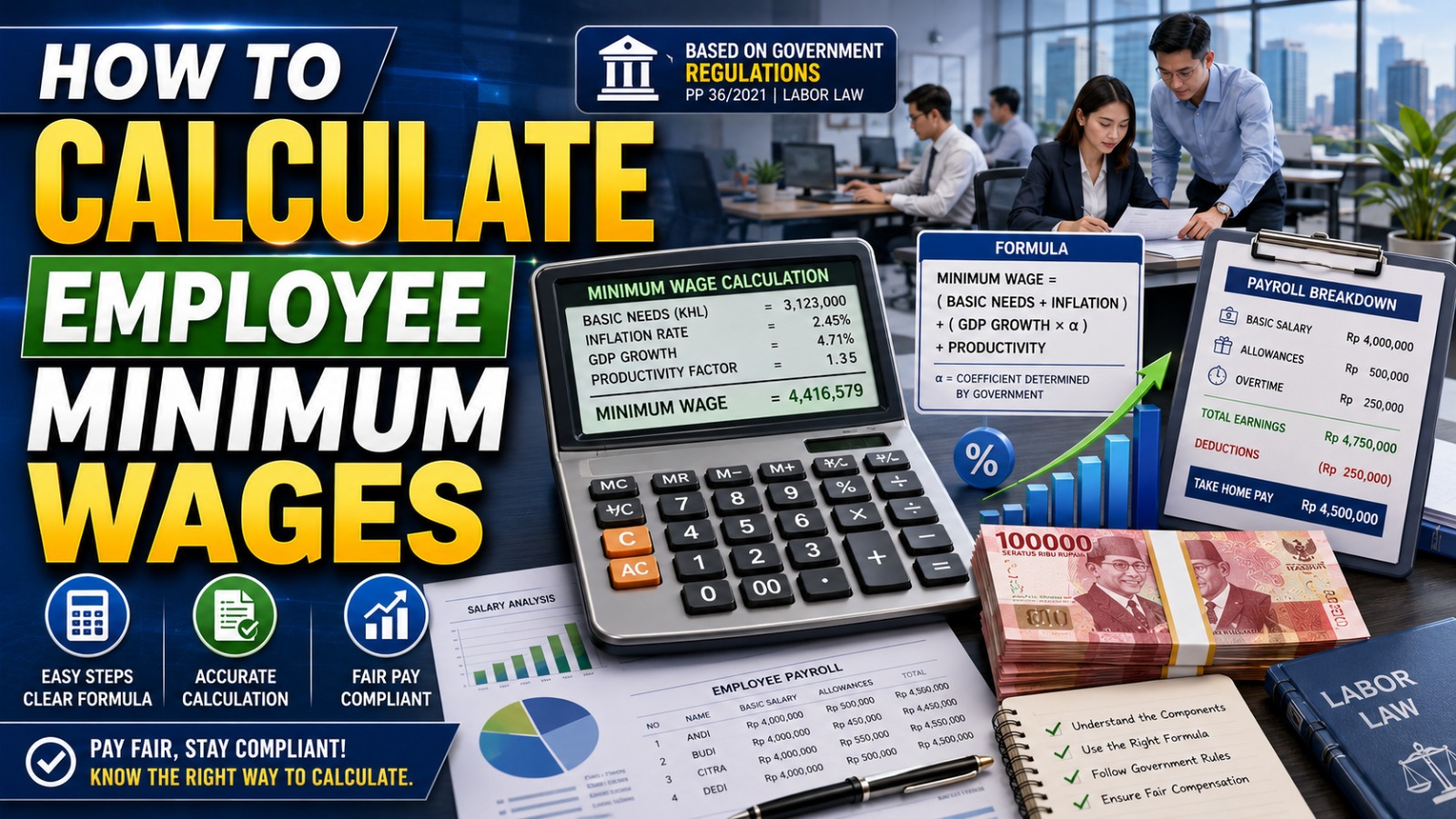
Employee minimum wages are one of the most important aspects of labor regulations and payroll management. Every company must understand how to calculate minimum wages correctly to ensure legal compliance and maintain employee satisfaction. Incorrect salary calculations can lead to disputes, financial penalties, and decreased worker morale.
This article explains how to calculate employee minimum wages accurately, including the factors that affect wage calculations and practical examples for businesses.
WHAT IS AN EMPLOYEE MINIMUM WAGE?
A minimum wage is the lowest amount of salary that employers are legally required to pay workers within a specific region or industry. Governments usually determine minimum wages based on economic conditions, inflation rates, and workers’ living needs.
In many countries, minimum wages can vary depending on:
- Province or region
- Industry sector
- Employee experience
- Working hours
- Company scale
Employers must follow the official wage regulations established by local authorities.
FACTORS THAT AFFECT MINIMUM WAGE CALCULATIONS
Several important factors influence how employee minimum wages are calculated. Understanding these elements helps companies avoid payroll errors.
Regional Wage Standards
Different regions may have different minimum wage levels. Urban areas often have higher wage standards than rural regions due to higher living costs.
Working Hours
Employee salaries are commonly calculated based on monthly or daily working hours. Overtime payments may also affect total earnings.
Employment Status
Permanent employees, contract workers, and part-time staff may have different wage structures depending on labor laws.
Allowances and Benefits
Some companies include transportation, meal, or attendance allowances as part of total compensation. However, basic salary requirements must still meet minimum wage standards.
HOW TO CALCULATE EMPLOYEE MINIMUM WAGES
Calculating minimum wages is relatively simple when using the correct formula. Employers should first determine the official minimum wage applicable in their region.
A common formula used is:
Daily Wage=Monthly Minimum Wage25\text{Daily Wage} = \frac{\text{Monthly Minimum Wage}}{25}Daily Wage=25Monthly Minimum Wage
For hourly calculations:
Hourly Wage=Monthly Minimum Wage173\text{Hourly Wage} = \frac{\text{Monthly Minimum Wage}}{173}Hourly Wage=173Monthly Minimum Wage
These formulas are widely used in payroll systems to determine fair employee compensation.
EXAMPLE OF MINIMUM WAGE CALCULATION
Suppose the monthly minimum wage in a region is $400.
To calculate the daily wage:
- Monthly wage = $400
- Standard working days = 25 days
The calculation becomes:
40025=16\frac{400}{25}=1625400=16
The employee’s daily wage would be $16 per day.
For hourly wages:
400173≈2.31\frac{400}{173}\approx2.31173400≈2.31
The employee would earn approximately $2.31 per hour.
COMMON MISTAKES IN MINIMUM WAGE CALCULATIONS
Many businesses still make payroll mistakes that can cause legal problems. Here are some common errors:
- Ignoring updated government wage regulations
- Miscalculating overtime pay
- Including non-fixed allowances as basic salary
- Paying below regional standards
- Incorrectly calculating part-time employee wages
Companies should regularly review labor policies to avoid these issues.
IMPORTANCE OF COMPLYING WITH MINIMUM WAGE REGULATIONS
Following minimum wage laws benefits both employers and employees. Proper compliance can help companies:
- Avoid legal sanctions
- Improve employee loyalty
- Increase productivity
- Build a positive company reputation
- Maintain fair workplace standards
Employees who receive fair compensation are generally more motivated and productive at work.
TIPS FOR COMPANIES WHEN MANAGING PAYROLL
To ensure accurate minimum wage calculations, businesses should:
- Use updated payroll software
- Monitor government wage announcements
- Keep detailed employee attendance records
- Train HR staff regularly
- Conduct payroll audits periodically
Effective payroll management reduces administrative errors and improves financial transparency.
CONCLUSION
Understanding how to calculate employee minimum wages is essential for every business. Accurate wage calculations help companies comply with labor laws while supporting employee welfare. By considering regional regulations, working hours, and employee status, businesses can create a fair and professional payroll system.
Employers who prioritize proper wage management are more likely to maintain stable operations and strong employee relationships in the long term.
About the Author
Gusti Ayu Tita P
Author — STEKOM University
An active author focused on academic issues, educational technology, and human resource development in the campus environment.