Strategies To Learn Deep Learning For Beginners Who Want An AI Career
Gusti Ayu Tita P
10 September 2026
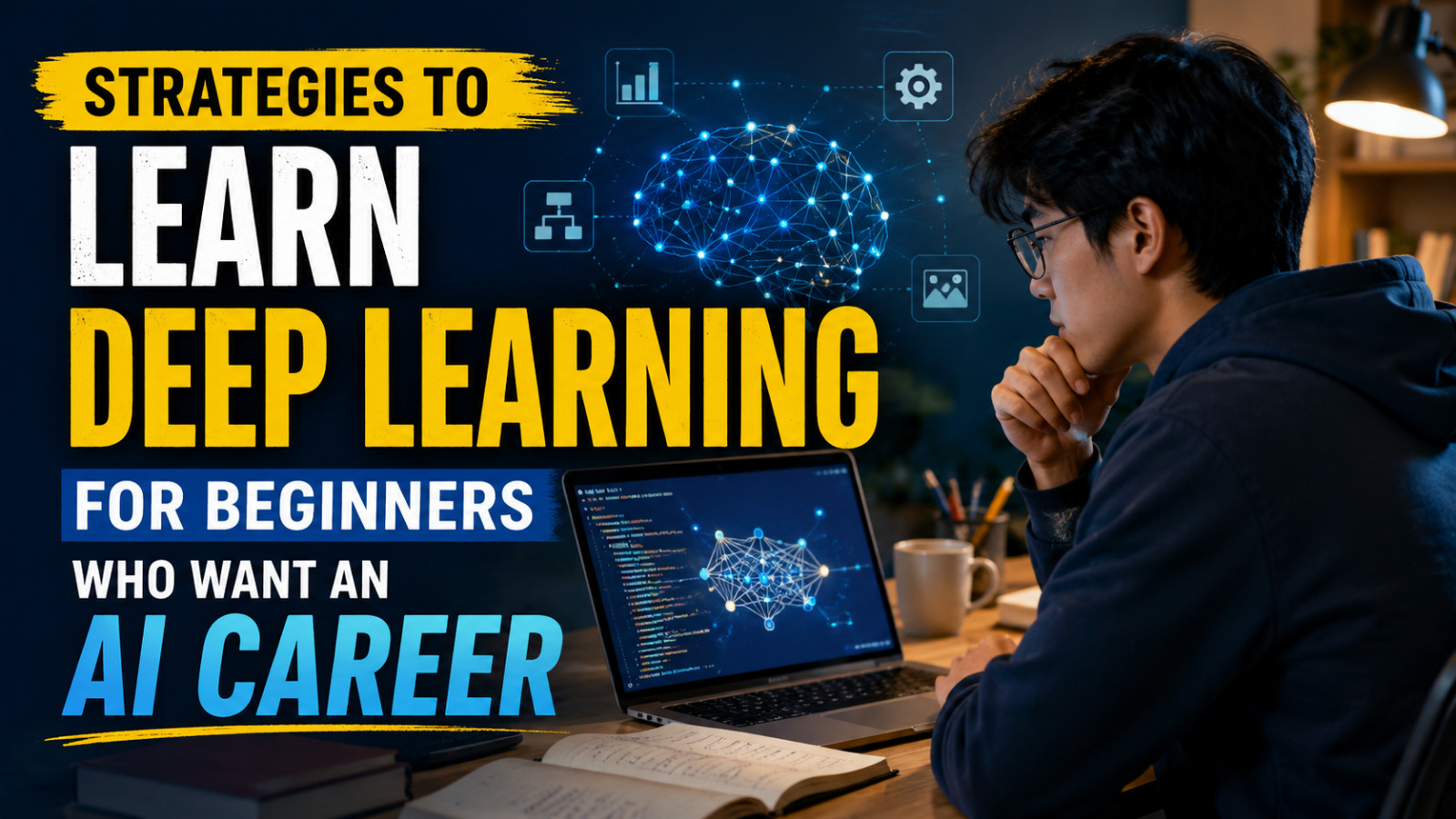
The rapid growth of Artificial Intelligence (AI) has created countless career opportunities across industries. From healthcare and finance to education and robotics, organizations increasingly rely on Deep Learning to solve complex problems and automate intelligent tasks. As a result, many beginners are eager to start learning this exciting field but often feel overwhelmed by the amount of information available.
Fortunately, mastering Deep Learning does not require a computer science degree. With the right learning strategy, consistent practice, and high-quality resources, anyone can build the skills needed to pursue a rewarding AI career. This article explains practical strategies that beginners can follow to learn Deep Learning efficiently while developing a strong foundation for long-term success.
UNDERSTAND THE FUNDAMENTALS BEFORE LEARNING DEEP LEARNING
The first step is to build a solid understanding of the basic concepts that support Deep Learning. Beginners should learn Python Programming, fundamental mathematics, statistics, and basic machine learning concepts before exploring advanced neural networks. These subjects make it easier to understand how AI models process data and make predictions.
Without a strong foundation, advanced topics may become confusing and discourage learning. Spend time mastering variables, functions, loops, probability, linear algebra, and calculus at a beginner-friendly level. A solid understanding of these concepts will make future learning much smoother and more enjoyable.
FOLLOW A STRUCTURED LEARNING ROADMAP
Learning randomly from different sources often leads to confusion and knowledge gaps. Instead, follow a structured roadmap that starts with Python Programming, continues with Machine Learning, and finally progresses to Deep Learning concepts such as neural networks, convolutional neural networks (CNNs), and recurrent neural networks (RNNs).
A clear roadmap allows beginners to measure progress and stay motivated. Focus on mastering one topic before moving to the next instead of rushing through multiple advanced subjects simultaneously. Consistent progress is far more valuable than learning many topics without understanding them deeply.
PRACTICE WITH REAL PROJECTS
Theory alone is not enough to become proficient in Deep Learning. Applying knowledge through practical projects helps reinforce concepts and improves problem-solving skills. Beginners can start with simple projects such as image classification, handwritten digit recognition, sentiment analysis, or basic object detection.
Each completed project strengthens both technical abilities and confidence. As experience grows, gradually work on more challenging AI applications while documenting the development process. A collection of well-documented projects also demonstrates practical expertise to future employers.
LEARN TO USE POPULAR DEEP LEARNING FRAMEWORKS
Modern AI development relies heavily on powerful frameworks that simplify model creation and training. Beginners should become familiar with TensorFlow, PyTorch, and other popular Deep Learning libraries. These frameworks provide pre-built tools that reduce coding complexity while allowing developers to build sophisticated AI models.
Learning one framework thoroughly before switching to another is usually more effective than trying to master several at once. Reading documentation, experimenting with tutorials, and modifying existing examples will gradually improve practical development skills.
IMPROVE YOUR MATHEMATICAL UNDERSTANDING
Although many tools automate calculations, mathematics remains an essential part of Deep Learning. Concepts such as Linear Algebra, Calculus, Probability, and Statistics explain why neural networks learn effectively and how optimization algorithms improve model performance.
Fortunately, beginners do not need to become mathematicians immediately. Focus on understanding the intuition behind mathematical concepts instead of memorizing formulas. As experience increases, deeper mathematical knowledge will naturally become easier to understand and apply.
BUILD A STRONG AI PORTFOLIO
Employers often value practical experience as much as academic qualifications. Creating a portfolio that showcases Deep Learning Projects demonstrates your technical skills, creativity, and ability to solve real-world problems. Include project descriptions, datasets used, model performance, and lessons learned.
Publishing projects on platforms such as GitHub also highlights your coding practices and continuous improvement. Updating your portfolio regularly reflects ongoing learning and helps distinguish you from other beginners entering the AI job market.
JOIN AI COMMUNITIES AND CONTINUE LEARNING
The field of Artificial Intelligence evolves rapidly, making continuous learning essential. Joining online communities, discussion forums, coding groups, and AI competitions exposes beginners to new ideas, practical advice, and industry trends. Interacting with experienced practitioners also helps solve technical challenges more efficiently.
Reading research articles, watching educational videos, and following AI experts further expands knowledge over time. Staying curious and maintaining a consistent learning habit are among the most valuable qualities for building a successful AI career.
CONCLUSION
Learning Deep Learning as a beginner is a journey that requires patience, consistency, and continuous practice. By building strong fundamentals, following a structured roadmap, working on real projects, mastering popular frameworks, improving mathematical understanding, creating an impressive portfolio, and actively participating in AI communities, beginners can develop the skills needed for a successful career in Artificial Intelligence.
Remember that progress comes through steady improvement rather than rushing toward advanced topics. With dedication and the right learning strategies, anyone can confidently enter the rapidly growing world of AI and build a rewarding future.
Tentang Penulis
Gusti Ayu Tita P
Penulis — Universitas STEKOM
Penulis aktif yang berfokus pada isu-isu akademik, teknologi pendidikan, dan pengembangan sumber daya manusia di lingkungan kampus.