Growth Strategies for Functional Positions
Gusti Ayu Tita P
12 Agustus 2026
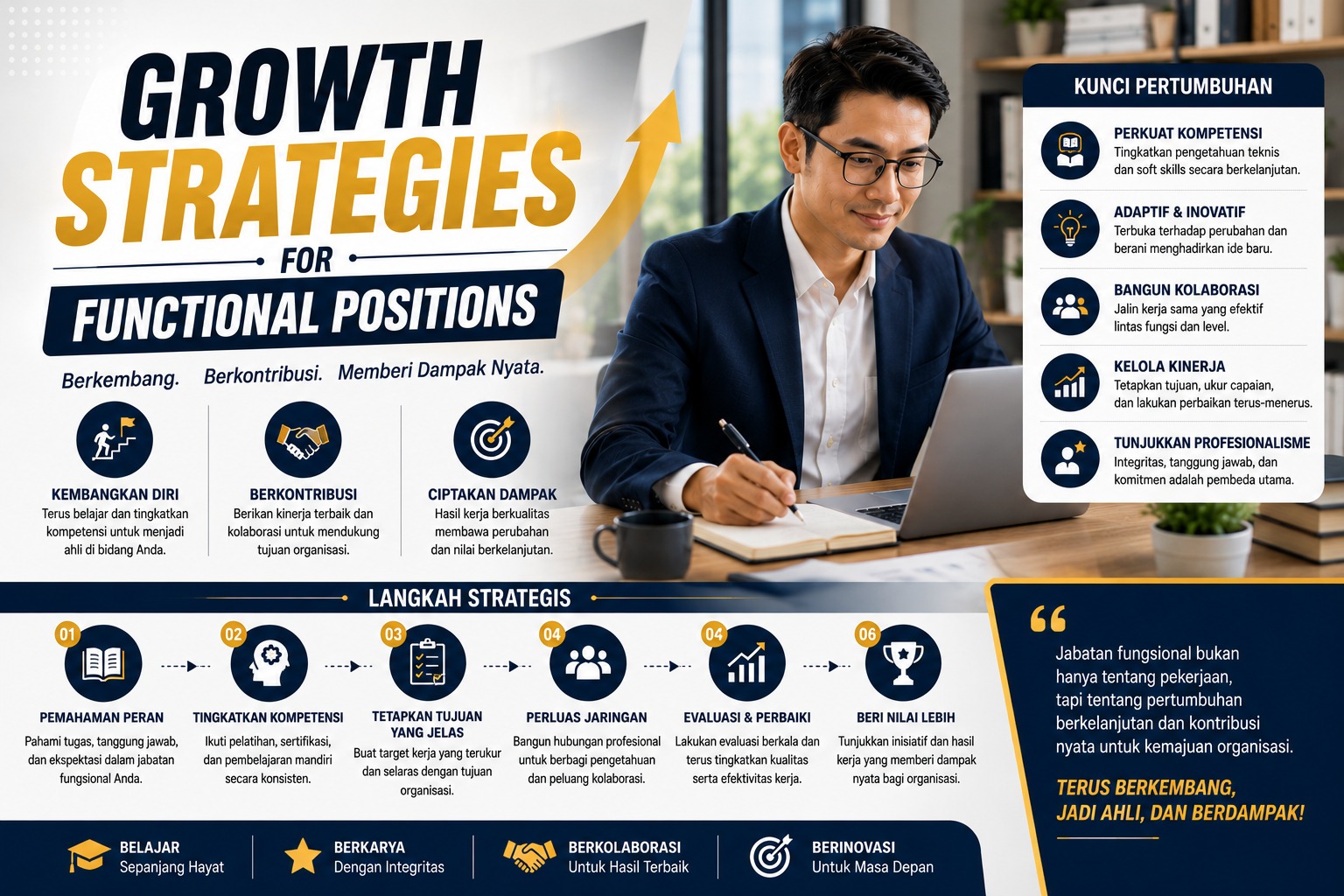
Building a successful career in a functional position requires more than completing daily responsibilities. Professionals need to continuously improve their skills, knowledge, performance, and professional attitude to remain relevant in a changing workplace. Functional positions provide opportunities for individuals to develop deeper expertise while contributing to organizational goals. With a clear growth strategy, professionals can turn their specialized abilities into long-term career opportunities.
Workplace demands continue to evolve because of technology, organizational changes, and new professional standards. These developments require employees to become more adaptable and proactive in managing their careers. A combination of continuous learning, performance improvement, digital skills, and career planning can help professionals grow effectively within functional positions.
UNDERSTANDING CAREER GROWTH IN FUNCTIONAL POSITIONS
Career growth in a functional position is closely connected to the development of professional expertise. Employees can strengthen their careers by improving their ability to perform increasingly complex responsibilities. Growth does not always mean moving into a managerial role. It can also involve becoming a more skilled, trusted, and knowledgeable professional within a specific field.
Understanding personal career goals is an important starting point. Professionals should identify the areas they want to specialize in and determine which competencies are needed to reach those goals. A clear direction makes career development more focused and helps employees choose appropriate learning and work experiences.
DEVELOPING SPECIALIZED COMPETENCIES
Specialized competencies are the foundation of functional positions. Professionals need to maintain strong technical knowledge and practical skills related to their responsibilities. As professional practices change, existing competencies may need to be updated or expanded. Continuous development helps employees remain capable of handling new tasks and challenges.
Competency development can take place through formal training, education, professional communities, mentoring, and practical experience. Employees should prioritize learning activities that are relevant to their current responsibilities and future goals. By developing expertise consistently, professionals can strengthen their professional value and career opportunities.
IMPROVING WORK PERFORMANCE
Strong performance is essential for sustainable career growth. Professionals should focus on producing work that is accurate, efficient, timely, and aligned with established standards. Performance quality can demonstrate an employee's ability to handle responsibilities effectively. Consistent results can also strengthen professional credibility within an organization.
Performance improvement requires regular evaluation. Professionals can review completed work, identify recurring problems, and seek constructive feedback from relevant colleagues or supervisors. Using these insights to improve work methods can create a cycle of continuous performance development.
STRENGTHENING DIGITAL SKILLS
Digital technology has become an important part of many functional positions. Professionals may use digital systems to manage information, analyze data, communicate, document work, or improve workflows. Developing digital competence can make employees more efficient and better prepared for workplace transformation.
However, digital skills should be developed according to actual professional needs. Learning every new tool is not always necessary if it does not support the individual's responsibilities. Professionals should focus on technologies that can improve productivity, accuracy, and decision-making within their field.
BUILDING PROFESSIONAL NETWORKS
Professional growth can also be supported by building meaningful connections with people in the same or related fields. Professional networks can provide opportunities to exchange knowledge, learn from experience, and discover developments within a particular profession. Interacting with other professionals can also introduce different approaches to solving workplace problems.
Networking should focus on creating genuine professional relationships rather than simply collecting contacts. Participation in professional communities, training programs, seminars, and collaborative projects can provide valuable learning experiences. A strong professional network can support knowledge sharing and career development over time.
DEVELOPING ADAPTABILITY AND LEARNING HABITS
Workplace conditions can change quickly, making adaptability an important professional competency. Employees may need to adjust to new technologies, procedures, responsibilities, or organizational priorities. Professionals who maintain a learning mindset are generally better prepared to respond to these changes.
Adaptability can be developed through regular reflection and willingness to try improved approaches. Professionals should evaluate whether their current methods remain effective and make adjustments when necessary. Developing consistent learning habits can help employees remain flexible and professionally relevant.
CREATING A LONG TERM CAREER PLAN
Career growth becomes more structured when professionals have clear long-term objectives. A career plan can identify the competencies, experiences, and achievements needed to reach future goals. Short-term targets can be connected to broader objectives so that daily professional development contributes to long-term career growth.
Career plans should also remain flexible. Changes in technology, professional requirements, or personal interests may create new opportunities or require different priorities. Reviewing the plan periodically allows professionals to remain focused while adapting to changing career conditions.
CONCLUSION
Growth strategies for functional positions involve continuous competency development, performance improvement, digital skills, professional networking, adaptability, and career planning. Professionals who actively manage these areas can strengthen their expertise while preparing for future responsibilities. Career growth does not happen automatically, but through consistent learning and purposeful improvement. By applying the right strategies, functional professionals can build a strong, relevant, and sustainable career.
About the Author
Gusti Ayu Tita P
Author — STEKOM University
An active author focused on academic issues, educational technology, and human resource development in the campus environment.