Tips to Get a Higher Salary as a Fresh Graduate
Gusti Ayu Tita P
14 Agustus 2026
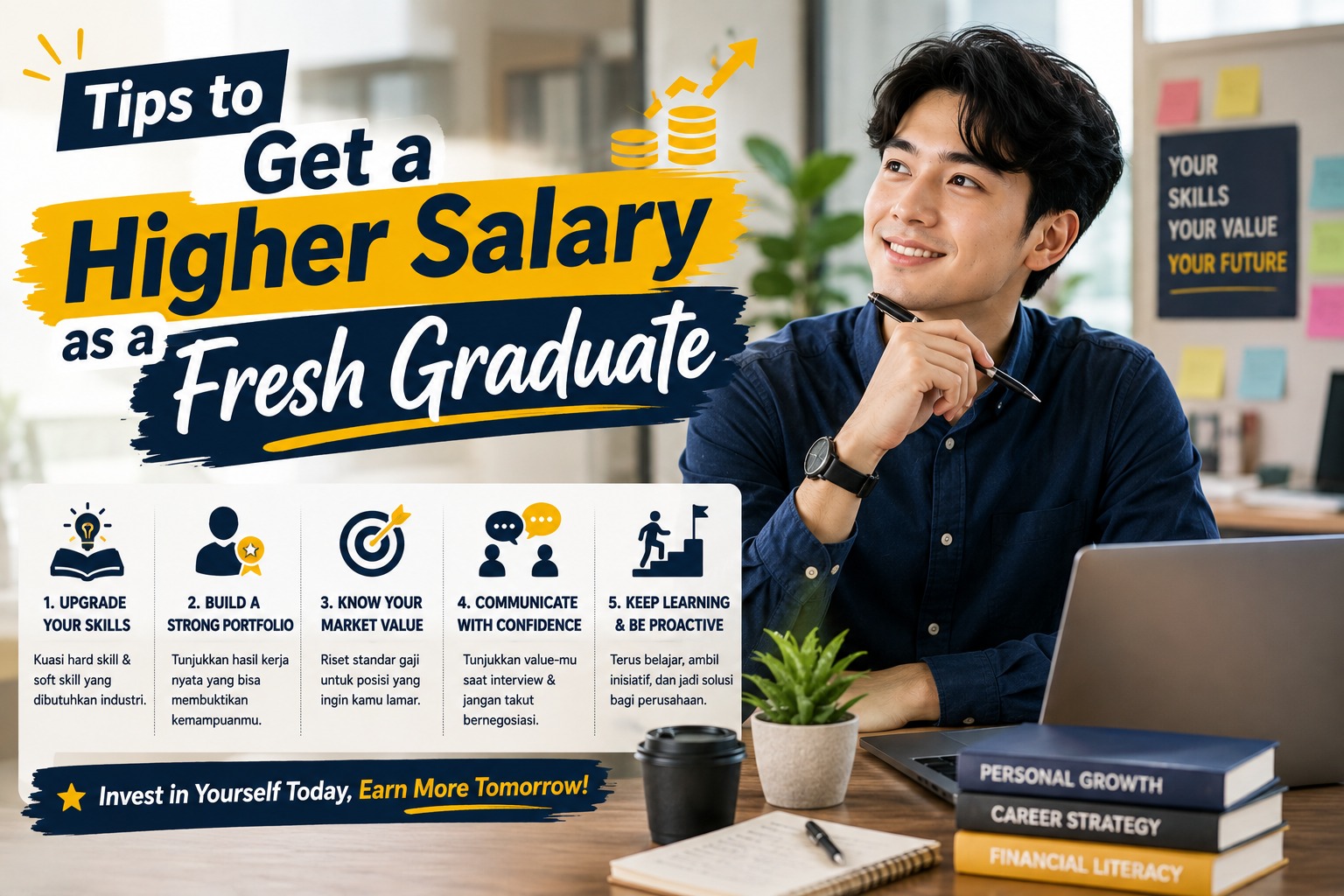
Getting a higher salary as a fresh graduate is a common goal for many students who are preparing to enter the workforce. However, a high starting salary is not determined by a college degree alone. Employers also consider practical skills, experience, communication abilities, portfolios, and the value a candidate can bring to the company. Therefore, fresh graduates need to prepare strategically before applying for jobs.
A competitive salary can also be influenced by the industry, position, location, and company. Instead of focusing only on a specific salary figure, graduates should build qualifications that strengthen their bargaining position. The better the combination of education, skills, experience, and professional attitude, the greater the opportunity to receive a competitive offer.
DEVELOP HIGH VALUE SKILLS
One of the most effective ways to improve salary potential is to develop skills that are in demand. Depending on the career path, these may include data analysis, programming, digital marketing, financial analysis, design, foreign languages, or other specialized abilities. Technical skills should be supported by soft skills such as communication, teamwork, critical thinking, and problem-solving. Employers are more likely to value candidates who can demonstrate how their skills can contribute to business goals.
Students should focus on mastering skills rather than simply collecting certificates. Choose skills that are relevant to the positions being targeted and practice them through real projects. Online courses, internships, competitions, and personal projects can provide useful opportunities to improve. Being able to demonstrate practical results can make a stronger impression than simply listing skills on a resume.
GAIN PRACTICAL EXPERIENCE BEFORE GRADUATION
Work experience can strengthen a fresh graduate's position during salary discussions. Internships are particularly useful because they expose students to professional workflows, deadlines, teamwork, and workplace expectations. Experience can also help graduates understand what employers actually require from entry-level candidates. Even short-term experiences can become valuable when they are relevant to the target career.
Students can also gain experience through freelance projects, student organizations, volunteering, competitions, or personal projects. The key is to choose activities that develop skills related to the desired job. For example, a student interested in marketing could manage a small social media campaign or create a marketing project. These experiences provide concrete examples that can be discussed during interviews.
BUILD A STRONG PORTFOLIO
A portfolio can provide evidence of what a fresh graduate is capable of doing. It is especially valuable for careers involving design, technology, writing, marketing, photography, data, and other project-based work. A portfolio can include academic projects, internship assignments, freelance work, or independent projects. Select examples that are relevant to the position rather than simply including everything that has ever been created.
Each project should explain the problem, the candidate's role, the tools used, and the outcome when appropriate. This gives recruiters a clearer understanding of the candidate's contribution. A well-organized portfolio can also make interviews easier because it provides specific examples to discuss. The goal is to show capability, not simply to create a visually impressive collection of work.
TARGET INDUSTRIES WITH STRONG OPPORTUNITIES
Salary levels can vary considerably between industries. Before applying, research the industries that have strong demand for the skills you possess. Technology, finance, engineering, consulting, healthcare, and other specialized sectors may have different compensation structures depending on the market and position. However, a high-paying industry is not automatically the right choice if the job does not match your abilities or interests.
Look at more than the starting salary when comparing opportunities. Consider career progression, training, benefits, bonuses, work responsibilities, and the skills you can develop. A position with slightly lower starting pay may provide stronger long-term growth. The goal should be to choose an opportunity that can increase your professional value over time.
CREATE A RESULTS FOCUSED RESUME
A resume should show more than education and job titles. Fresh graduates should describe their experiences by emphasizing responsibilities, contributions, and measurable results when possible. Instead of simply saying that you participated in an organization, explain what you handled and what was achieved. Specific information can make a candidate's experience more convincing.
The resume should also be adjusted for each position. Highlight skills and experiences that are directly connected to the job description. Avoid filling the document with irrelevant information simply to make it longer. A clear and targeted resume can help recruiters quickly understand why you are a suitable candidate.
IMPROVE YOUR INTERVIEW SKILLS
Strong interview performance can influence how employers perceive a candidate's readiness and professional potential. Fresh graduates should practice explaining their education, skills, projects, internships, and achievements clearly. Use real examples to demonstrate problem-solving, teamwork, leadership, and adaptability. Avoid exaggerating abilities because employers may test those skills during the recruitment process.
Research the company and position before attending an interview. Understanding the company's products, services, industry, and job requirements can help you give more relevant answers. Practice common questions while maintaining a natural communication style. Confidence is important, but it should be combined with honesty and a willingness to learn.
LEARN HOW TO NEGOTIATE SALARY
Salary negotiation can be challenging for fresh graduates, especially when they have limited professional experience. Before discussing salary, research compensation ranges for the position based on industry, location, and level of responsibility. Use reliable market information as a reference rather than choosing an arbitrary number. Your expected salary should also reflect your skills, experience, and the value you can reasonably provide.
When an employer asks about salary expectations, providing a reasonable range can leave room for discussion. Explain your expectations professionally and remain open to the overall compensation package. Consider benefits, bonuses, allowances, training, and career opportunities in addition to base salary. Effective negotiation is not about demanding the highest possible number but finding a fair agreement.
BUILD A PROFESSIONAL NETWORK
Professional networking can help fresh graduates discover career opportunities and learn about industry expectations. Build relationships with lecturers, alumni, internship supervisors, professional communities, recruiters, and people working in your target industry. These connections can provide valuable insights about skills, recruitment processes, and potential job openings. Networking can be especially useful when opportunities are not publicly advertised.
Good networking should be based on genuine professional relationships. Avoid contacting people only when you need a job or referral. Participate in discussions, attend professional events, and share relevant projects or achievements when appropriate. Over time, a strong professional network can support career development and increase access to new opportunities.
CONTINUE LEARNING AFTER GETTING A JOB
Getting a competitive starting salary is only the beginning of career development. Fresh graduates should continue improving their skills after entering the workforce. New technologies, tools, and business practices can change the requirements of many jobs. Staying current can help employees remain valuable and prepared for greater responsibilities.
Track your achievements and improvements as your career develops. Successful projects, increased responsibilities, cost savings, revenue contributions, or other measurable results can support future salary discussions. If career growth becomes limited, your accumulated skills and experience can also help you explore better opportunities elsewhere. Continuous development is one of the strongest ways to increase long-term earning potential.
CONCLUSION
Tips to get a higher salary as a fresh graduate include developing valuable skills, gaining practical experience, building a strong portfolio, targeting suitable industries, and creating a results-focused resume. Fresh graduates should also improve their interview skills, learn professional salary negotiation, and build a strong network. These steps can increase their competitiveness when applying for entry-level positions.
A higher salary should not be pursued at the expense of long-term career development. Consider learning opportunities, benefits, responsibilities, company culture, and career progression when evaluating a job offer. By consistently improving professional value and gaining relevant experience, fresh graduates can increase their chances of earning competitive salaries and achieving sustainable career growth.
About the Author
Gusti Ayu Tita P
Author — STEKOM University
An active author focused on academic issues, educational technology, and human resource development in the campus environment.