Challenges and Opportunities of the Metaverse
Gusti Ayu Tita P
10 Mei 2026
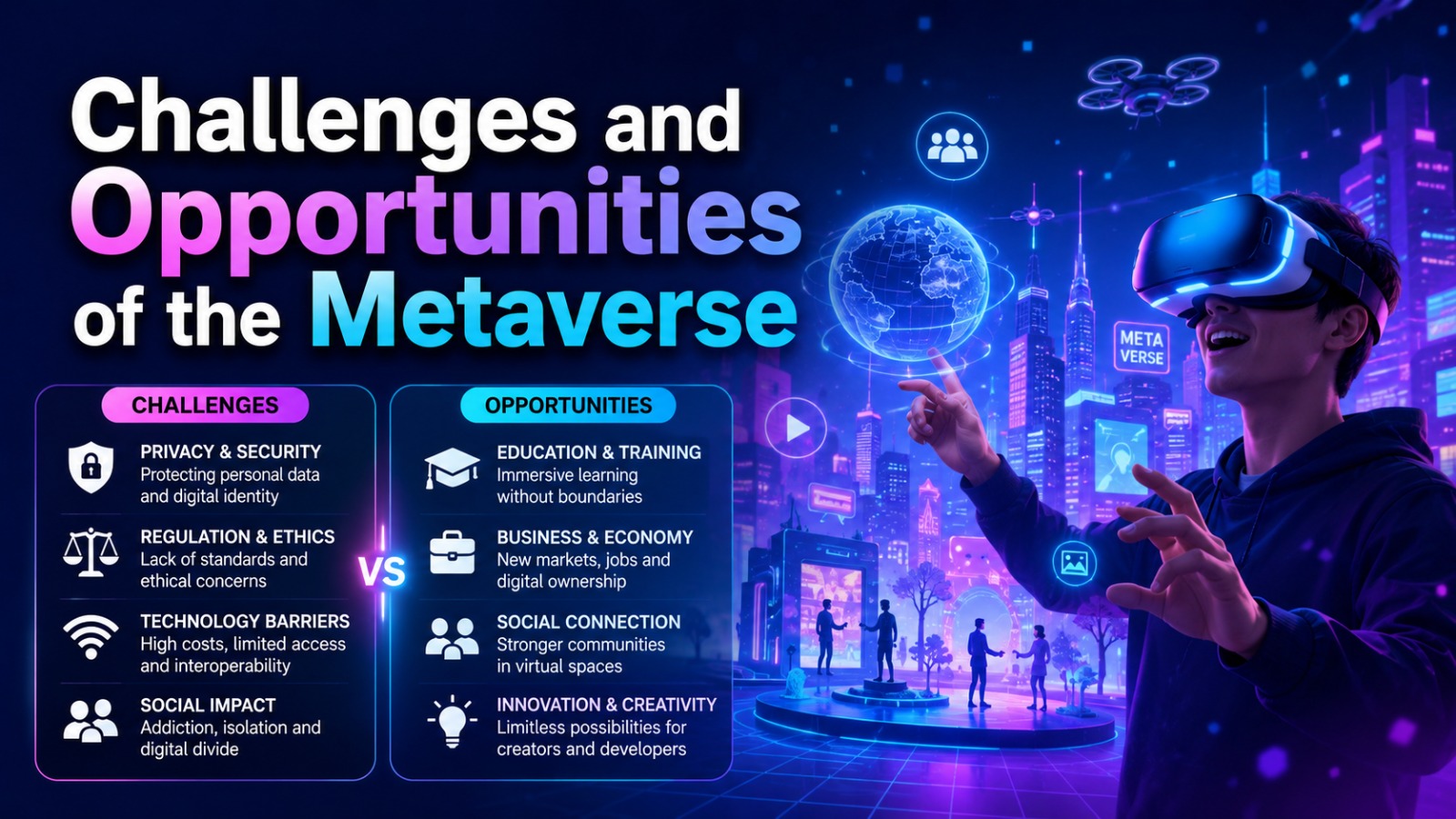
The metaverse has emerged as one of the most discussed technological concepts in recent years, promising to transform how people interact, work, learn, and entertain themselves in digital environments. Defined as a network of interconnected virtual spaces where users can socialize and engage through digital avatars, the metaverse is increasingly viewed as the next evolution of the internet. While the concept offers immense possibilities, it also presents substantial challenges that must be addressed before widespread adoption can occur.
UNDERSTANDING THE METAVERSE
The metaverse combines virtual reality, augmented reality, blockchain, artificial intelligence, and immersive digital experiences into a shared online ecosystem. Unlike traditional websites or social media platforms, the metaverse enables users to participate in interactive three-dimensional spaces that simulate real-world and fictional environments.
Businesses, educational institutions, entertainment companies, and developers are investing heavily in metaverse infrastructure to create virtual marketplaces, workplaces, classrooms, and gaming worlds. This growing investment reflects the belief that immersive digital environments may become central to daily life in the future.
OPPORTUNITIES CREATED BY THE METAVERSE
One of the greatest opportunities presented by the metaverse is the creation of new digital economies. Virtual real estate, digital fashion, NFTs, and immersive services have opened new revenue streams for creators and businesses. Brands can establish virtual storefronts, host events, and engage with consumers in highly interactive ways.
The metaverse also offers transformative potential for education and training. Students can learn through immersive simulations, while professionals can practice complex tasks in virtual environments without physical risks. Industries such as healthcare, aviation, and engineering are already exploring metaverse-based training programs.
Remote work may also benefit significantly from metaverse development. Virtual offices and collaborative 3D workspaces can create more engaging remote interactions than traditional video conferencing, potentially improving communication and productivity.
MAJOR CHALLENGES OF THE METAVERSE
Despite its potential, the metaverse faces serious technological limitations. High-quality virtual experiences require advanced hardware, fast internet connections, and significant computing power. These requirements may limit accessibility for users in regions with weaker infrastructure.
Privacy and data security represent another major concern. The metaverse could collect unprecedented amounts of personal data, including biometric information, behavioral patterns, and real-time interactions. Protecting this data will be critical to maintaining user trust.
Regulatory uncertainty also presents obstacles. Governments and legal institutions have yet to establish comprehensive frameworks for virtual property rights, taxation, identity verification, and digital conduct within metaverse environments.
SOCIAL AND ETHICAL CONSIDERATIONS
The metaverse raises important ethical questions regarding addiction, mental health, digital identity, and online harassment. Prolonged immersion in virtual environments may affect social behavior and psychological well-being if not managed responsibly.
There are also concerns about inclusivity and accessibility. If metaverse platforms remain expensive or technologically demanding, they could deepen the digital divide rather than reduce it.
THE FUTURE OF THE METAVERSE
The long-term success of the metaverse will depend on how effectively developers, governments, and businesses address its technical, ethical, and regulatory challenges. Interoperability between platforms, affordable hardware, and stronger digital protections will be essential for mainstream adoption.
As technology advances, the metaverse may become an integral part of digital communication, commerce, and entertainment. However, its development must be guided carefully to ensure that innovation is balanced with safety, accessibility, and ethical responsibility.
CONCLUSION
The metaverse presents both exciting opportunities and significant challenges. It has the potential to reshape industries, redefine online interaction, and create entirely new digital economies. At the same time, issues related to privacy, regulation, accessibility, and mental health must be carefully addressed. As the metaverse continues to evolve, its ultimate impact will depend on how society chooses to develop and regulate this emerging digital frontier.
Tentang Penulis
Gusti Ayu Tita P
Penulis — Universitas STEKOM
Penulis aktif yang berfokus pada isu-isu akademik, teknologi pendidikan, dan pengembangan sumber daya manusia di lingkungan kampus.