The Important Role of Outer Space in Understanding the Origins of the Universe
Gusti Ayu Tita P
10 Mei 2026
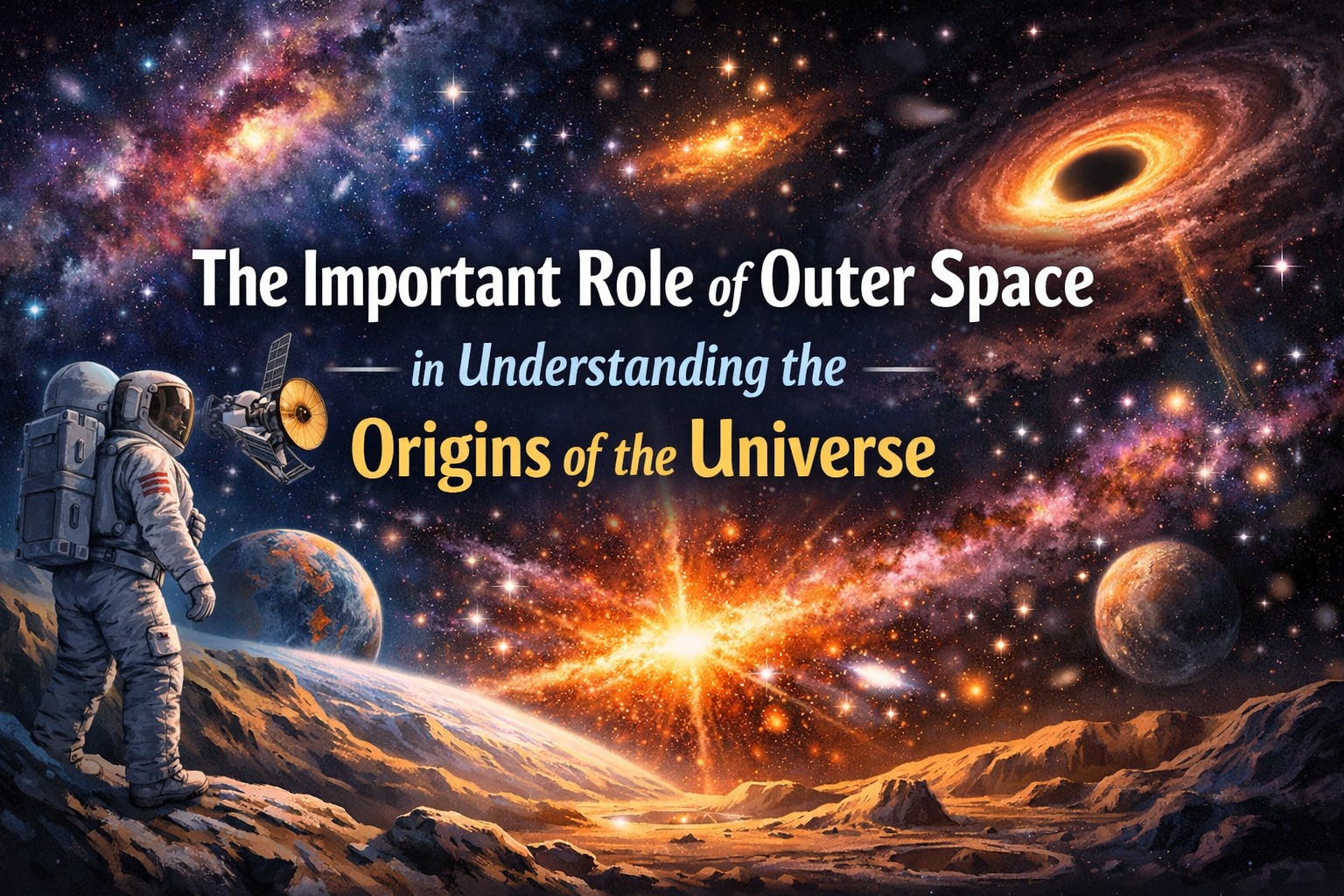
Human curiosity about the beginning of everything has driven science for centuries. One of the most powerful tools in answering these deep questions is the exploration of outer space. By observing galaxies, stars, and cosmic radiation, scientists are gradually uncovering how the universe was formed and how it continues to evolve. Outer space is not just a vast and mysterious void—it is a living archive of cosmic history.
WHY OUTER SPACE IS KEY TO COSMIC ORIGINS
Outer space holds the oldest and most distant objects in existence. Light from faraway galaxies takes billions of years to reach Earth, meaning astronomers are essentially looking back in time when they observe the universe. This allows researchers to study conditions that existed shortly after the Big Bang.
The distribution of galaxies, dark matter, and cosmic structures also helps scientists understand how matter was organized in the early universe. Without space observation, these clues would remain completely hidden.
THE ROLE OF SPACE TELESCOPE TECHNOLOGY
Advanced space telescopes have revolutionized our understanding of the universe. Instruments like the Hubble Space Telescope and the James Webb Space Telescope capture high-resolution images of distant galaxies, nebulae, and exoplanets.
These telescopes are placed beyond Earth’s atmosphere to avoid distortion caused by air and light pollution. As a result, they provide clearer and more accurate data, helping scientists study the earliest stages of cosmic formation with unprecedented detail.
COSMIC MICROWAVE BACKGROUND AS A TIME CAPSULE
One of the most important discoveries in modern cosmology is the Cosmic Microwave Background (CMB). This faint radiation is considered the afterglow of the Big Bang and provides a snapshot of the universe when it was only about 380,000 years old.
By analyzing variations in the CMB, scientists can determine the age, shape, and composition of the universe. This information is crucial for building accurate models of how everything began.
DARK MATTER AND DARK ENERGY EXPLORATION
Outer space studies have also revealed the existence of dark matter and dark energy—two of the most mysterious components of the universe. Although they cannot be seen directly, their effects on galaxies and cosmic expansion are undeniable.
Dark matter helps hold galaxies together, while dark energy is believed to be responsible for the accelerating expansion of the universe. Understanding these forces is essential to fully grasp the origin and future of the cosmos.
CONCLUSION
Outer space plays a fundamental role in helping humanity understand where the universe came from and how it continues to evolve. Through advanced technology, deep-space observation, and cosmic data analysis, scientists are slowly uncovering the story of creation itself. While many mysteries remain, each discovery brings us closer to answering one of the greatest questions in existence: how did the universe begin?
Tentang Penulis
Gusti Ayu Tita P
Penulis — Universitas STEKOM
Penulis aktif yang berfokus pada isu-isu akademik, teknologi pendidikan, dan pengembangan sumber daya manusia di lingkungan kampus.