What Is the Connection Between Inner Conflict and Difficulty Making Decisions?
Gusti Ayu Tita P
21 September 2026
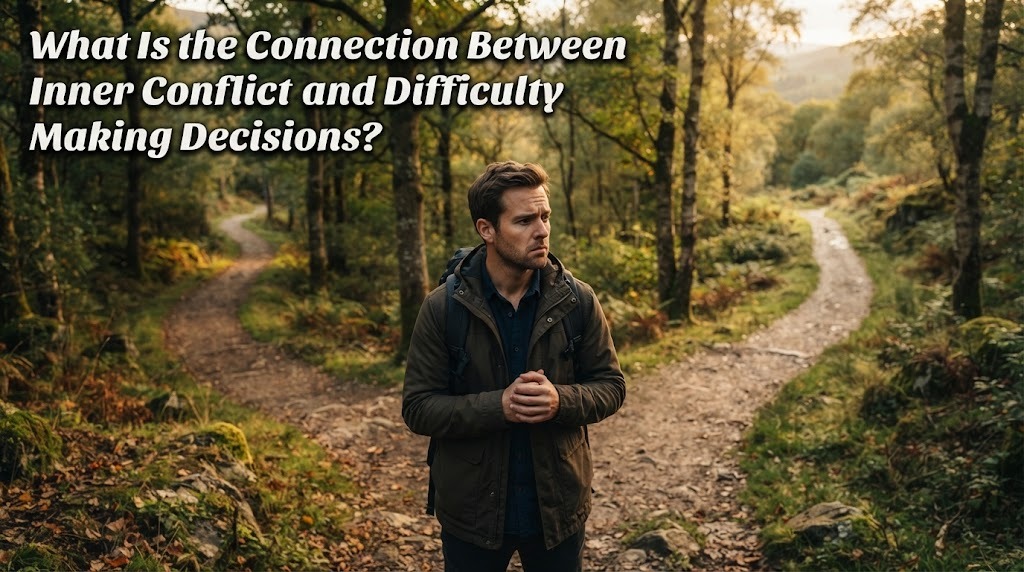
Inner conflict and difficulty making decisions are closely connected because conflicting thoughts and emotions can make it harder to determine what choice feels right. A person may understand the advantages of one option while emotionally preferring another. This disagreement can create uncertainty, overthinking, and low decision-making confidence. As a result, even an important but manageable decision can feel overwhelming.
Decision-making usually requires a person to consider information, personal values, emotions, and possible consequences. When these factors point in different directions, internal tension can develop. Understanding this connection can help someone recognize why they struggle to choose and find a more balanced way to approach difficult decisions.
HOW DOES INNER CONFLICT MAKE DECISIONS DIFFICULT?
Inner conflict can make decisions difficult because the mind receives competing priorities. One part of a person may want to choose an option because it feels emotionally satisfying, while another part may prefer a different option because it appears more practical. When both sides seem important, reaching a clear conclusion becomes harder.
The person may continue comparing the choices without feeling satisfied with either one. They might also repeatedly change their mind after considering another possibility. This does not necessarily mean that the person lacks the ability to make decisions. It may simply show that several important factors are competing for attention.
WHY DOES OVERTHINKING AFFECT DECISION MAKING?
Overthinking can make decision-making more difficult by keeping the mind focused on the same question for too long. A person may repeatedly analyze advantages, disadvantages, possible risks, and imagined outcomes. While careful consideration can be useful, excessive analysis may create more uncertainty instead of greater clarity.
Overthinking can also create a desire for complete certainty. However, most important decisions involve some level of risk or unknown information. Waiting for a decision to feel completely perfect may therefore lead to unnecessary delays. Focusing on realistic information and what can actually be controlled can support clearer decision-making.
CAN EMOTIONS MAKE A DECISION MORE COMPLICATED?
Yes, emotions can strongly influence how a person evaluates different options. Feelings such as fear, attachment, guilt, excitement, or disappointment may affect the importance given to each choice. A person may know what seems logical but still feel emotionally uncomfortable about choosing it. This can create significant emotional tension.
Emotions are not necessarily obstacles to good decisions. They can provide information about personal values, needs, and concerns. The important step is to understand what the emotion is communicating rather than allowing it to automatically control the decision. Combining emotional awareness with factual information can create a more balanced perspective.
HOW DOES FEAR OF MAKING A MISTAKE INCREASE INNER CONFLICT?
Fear of making the wrong decision can make an existing inner conflict stronger. Someone may worry about regret, failure, criticism, or negative consequences after choosing one option. This fear can cause the person to delay the decision because postponing it feels safer than accepting responsibility for an uncertain outcome.
However, avoiding a decision does not always eliminate its consequences. Delaying a choice may create additional stress or reduce available opportunities. Accepting reasonable uncertainty can help a person understand that a thoughtful decision does not have to guarantee a perfect result. What matters is using available information and considering realistic consequences.
WHY CAN PERSONAL VALUES CAUSE DECISION CONFLICT?
Personal values can create inner conflict when two important principles point toward different choices. Someone may value security and independence, for example, but a particular decision may require sacrificing one to gain more of the other. Similar conflicts can happen between family responsibilities and personal goals, or between financial stability and personal satisfaction.
The conflict becomes easier to understand when a person identifies which values are involved. Instead of simply asking which option is better, they can ask what each option represents and what they are willing to prioritize. This approach can provide greater self-awareness and make difficult choices more meaningful.
HOW CAN SOMEONE MAKE DECISIONS DESPITE INNER CONFLICT?
A useful first step is to separate facts, emotions, fears, and expectations. Writing down the available choices can make it easier to see which concerns are realistic and which may be based on assumptions. The person can then consider the likely consequences of each option and identify what matters most in the current situation.
It can also help to set a reasonable time for reflection rather than analyzing the same decision indefinitely. A trusted person can provide another perspective without taking control of the choice. Once enough information has been considered, accepting that some uncertainty will remain can make it easier to move forward. The goal is not to eliminate every conflicting thought but to make a thoughtful and responsible decision.
CONCLUSION
Inner conflict can make decision-making difficult because competing thoughts, emotions, values, and fears may point toward different choices. Overthinking, fear of mistakes, emotional attachment, and uncertainty can further increase the difficulty. Recognizing these factors can help a person understand why they feel stuck instead of simply blaming themselves for indecision. Through self-awareness, realistic thinking, emotional understanding, and balanced decision-making, people can make choices more calmly while accepting that no important decision comes with complete certainty.
Tentang Penulis
Gusti Ayu Tita P
Penulis — Universitas STEKOM
Penulis aktif yang berfokus pada isu-isu akademik, teknologi pendidikan, dan pengembangan sumber daya manusia di lingkungan kampus.