What Makes Inner Conflict Difficult to Resolve Alone?
Gusti Ayu Tita P
21 September 2026
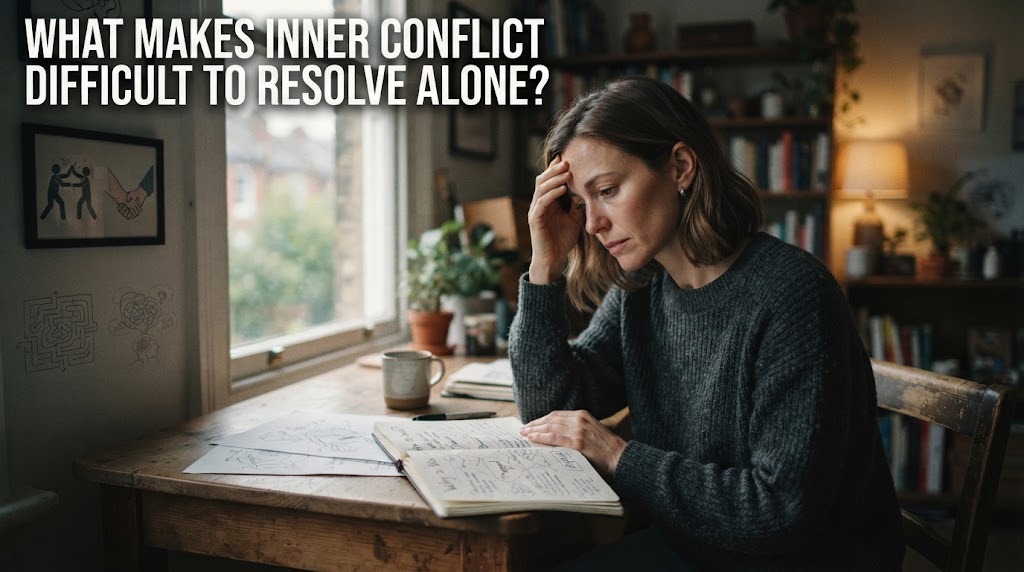
Inner conflict can be difficult to resolve alone because it involves thoughts, emotions, values, fears, and personal expectations that may point in different directions. When someone is directly involved in the problem, it can be difficult to see the situation objectively. The person may repeatedly analyze the same issue without discovering a clear solution. This can create overthinking, self-doubt, emotional pressure, and decision-making difficulties.
Trying to understand yourself independently can be useful, but some situations become easier when another perspective is available. A trusted person can notice things that may be difficult to recognize from inside the conflict. Understanding why inner conflict can be difficult to manage alone can help someone know when reflection is enough and when additional support may be helpful.
WHY IS IT HARD TO SEE INNER CONFLICT OBJECTIVELY?
It can be difficult to view an inner conflict objectively because the person is emotionally involved in the situation. Strong feelings may influence how they interpret information, possible consequences, and other people's actions. When emotions and thoughts are closely connected, it can become challenging to separate facts from personal assumptions. This may make the problem seem more complicated than it actually is.
A person may also focus on the part of the situation that causes the strongest emotional reaction. Emotional involvement can make certain possibilities appear more important while other information receives less attention. Taking a short mental step back can help create a clearer perspective. However, doing this alone may be difficult when the conflict has been present for a long time.
HOW DOES OVERTHINKING MAKE INNER CONFLICT HARDER TO RESOLVE?
Overthinking can keep a person trapped in the same internal discussion. They may repeatedly compare choices, replay conversations, imagine different outcomes, or question previous decisions. Although careful thinking can help, repeating the same analysis without new information may not bring greater clarity. Instead, it can increase mental fatigue and uncertainty.
Overthinking can also create the expectation that there must be a perfect answer. Many personal situations involve uncertainty, and no decision can guarantee a completely positive outcome. A different perspective may help someone recognize when they have already considered enough information. This can make it easier to move from endless analysis toward balanced decision-making.
WHY CAN EMOTIONS MAKE SELF-REFLECTION MORE DIFFICULT?
Emotions can make self-reflection difficult because they may change the way a person understands their own situation. Fear may make a risk seem larger, while guilt may make someone prioritize another person's needs over their own. Attachment can also make it difficult to consider an option that involves change or separation. These emotions are meaningful, but they can complicate the decision-making process.
A person may also struggle to identify exactly what they are feeling. They might describe the situation as confusion when the deeper issue involves fear, disappointment, pressure, or unmet expectations. Emotional awareness can help clarify these feelings, but discovering them may take time. Speaking with someone trustworthy can sometimes make it easier to put unclear emotions into words.
CAN LACK OF ANOTHER PERSPECTIVE KEEP THE CONFLICT GOING?
Yes, a lack of another perspective can sometimes allow an inner conflict to continue. When someone thinks about the same issue alone, they may repeatedly return to the same assumptions and interpretations. They may not notice information that challenges their current way of thinking. This can create a mental cycle that feels difficult to escape.
Another person does not need to make the decision for them. A trusted friend, family member, mentor, or professional can simply ask questions or offer a different way of looking at the situation. A fresh perspective may reveal options or concerns that were previously overlooked. The final decision can still remain with the person experiencing the conflict.
HOW CAN FEAR AND SELF-DOUBT PREVENT RESOLUTION?
Fear of making the wrong choice can make inner conflict difficult to resolve. A person may worry about regret, failure, criticism, disappointing others, or losing an important opportunity. Because of these concerns, they may continue waiting for complete certainty before acting. This can cause the conflict to remain unresolved.
Self-doubt can make the situation even more difficult. Someone may question whether they can trust their own judgment or handle the consequences of their decision. Self-confidence does not require knowing exactly what will happen. It means recognizing that you can make a thoughtful decision and respond to challenges even when some uncertainty remains.
WHEN SHOULD SOMEONE CONSIDER SUPPORT FROM OTHERS?
Seeking support can be useful when inner conflict continues to affect daily activities, relationships, work, education, sleep, or emotional well-being. A person does not need to wait until the situation becomes overwhelming before talking to someone. Sharing concerns with a trusted person can provide emotional space and a different perspective. The goal is not necessarily to receive an immediate answer.
Professional support may also be appropriate when the conflict feels persistent or difficult to manage. A qualified professional can provide a structured environment for exploring thoughts, emotions, and patterns of behavior. Seeking support is not a sign of weakness. It can be a practical way to understand a complicated situation and develop healthier ways of responding to it.
CONCLUSION
Inner conflict can be difficult to resolve alone because emotional involvement, overthinking, fear, self-doubt, and limited perspectives can make the situation harder to understand clearly. Trying to manage everything independently may sometimes lead to repeated analysis without meaningful progress. A trusted person or qualified professional can provide another perspective without taking control of the decision. Through self-awareness, emotional understanding, balanced thinking, and appropriate support, someone can gradually gain greater clarity and handle inner conflict more effectively.
Tentang Penulis
Gusti Ayu Tita P
Penulis — Universitas STEKOM
Penulis aktif yang berfokus pada isu-isu akademik, teknologi pendidikan, dan pengembangan sumber daya manusia di lingkungan kampus.