
Why Does Inner Conflict Often Make the Mind Feel Restless?
Gusti Ayu Tita P
21 September 2026
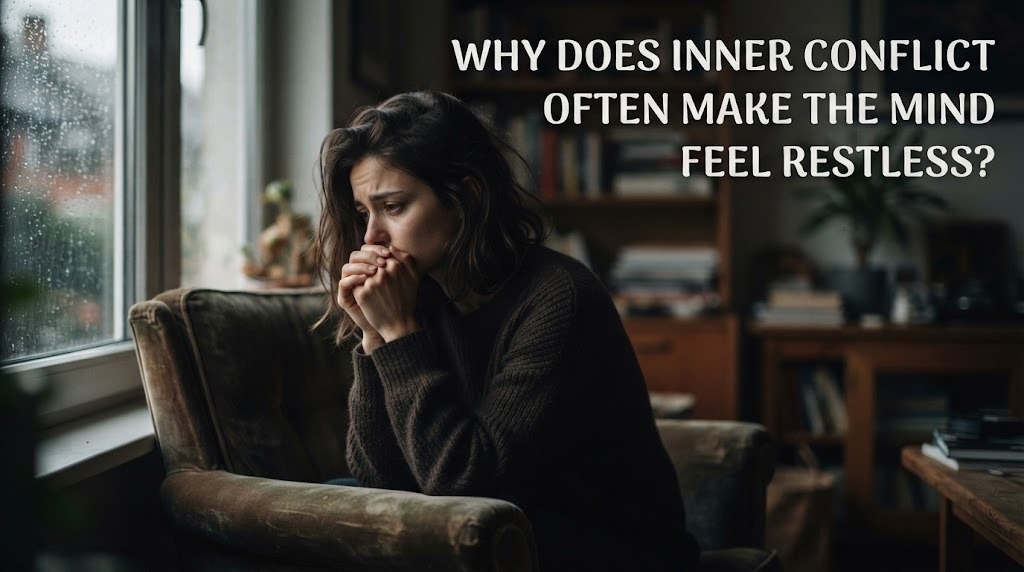
Inner conflict can make the mind feel restless because a person is trying to deal with thoughts, emotions, values, or desires that do not agree with one another. The mind may continue searching for an answer even when there is no immediate solution. This can create mental tension, uncertainty, overthinking, and emotional discomfort. As a result, a person may find it difficult to feel calm even during ordinary daily activities.
Mental restlessness can appear in different ways. Someone may repeatedly think about the same problem, have difficulty concentrating, or feel uncomfortable when there is nothing to distract them. Understanding why inner conflict creates this feeling can help a person recognize the source of the restlessness and manage it more effectively.
HOW DOES INNER CONFLICT CREATE MENTAL TENSION?
Inner conflict creates mental tension when different thoughts or emotions compete for attention. For example, a person may want to make a particular decision but simultaneously worry about its consequences. The mind continues comparing these opposing possibilities because neither side feels completely satisfying. This ongoing internal discussion can make it difficult to relax.
The tension may become stronger when the issue feels important or personal. A person may repeatedly ask whether they are doing the right thing or whether another choice would be better. Even without taking physical action, the brain remains occupied with the unresolved issue. Unresolved thoughts can therefore make the mind feel continuously active.
WHY DOES OVERTHINKING MAKE THE MIND RESTLESS?
Overthinking is closely connected to mental restlessness because it keeps the mind focused on the same unresolved question. A person may replay conversations, imagine different outcomes, or analyze every possible consequence of a decision. Although thinking carefully can be useful, repetitive analysis does not always produce a solution.
The problem becomes greater when someone expects complete certainty before taking action. Many situations involve uncertainty, and no decision can guarantee a perfect outcome. Accepting that some uncertainty is normal can reduce unnecessary mental pressure. Focusing on what can actually be controlled may also create greater mental clarity.
CAN EMOTIONAL UNCERTAINTY CAUSE RESTLESSNESS?
Yes, emotional uncertainty can contribute to a restless mind. A person may not fully understand whether they feel happy, afraid, disappointed, attached, or conflicted about a particular situation. When emotions are unclear, it can become difficult to determine what action feels appropriate. This uncertainty can encourage further questioning and self-analysis.
Emotional uncertainty may also change throughout the day. Someone might feel confident about a decision at one moment and doubtful about it later. These changes do not necessarily mean that something is wrong. They may simply indicate that the person needs more time to understand their feelings and priorities.
HOW DOES FEAR KEEP THE MIND ACTIVE?
Fear can make the mind remain focused on possible negative outcomes. Someone experiencing inner conflict may worry about making a mistake, losing an opportunity, disappointing another person, or regretting a decision. These concerns can lead to repeated mental simulations of what might happen. As a result, the person may find it difficult to mentally switch off.
However, not every concern is unrealistic. Some fears may be based on genuine risks that deserve consideration. The useful approach is to distinguish realistic concerns from imagined possibilities. Identifying what can be prepared for and what cannot be controlled can help reduce unnecessary worry.
CAN INNER CONFLICT AFFECT SLEEP AND DAILY FOCUS?
Persistent mental restlessness can sometimes make it harder to concentrate on everyday activities. A person may be studying, working, or talking to someone while their attention repeatedly returns to the unresolved conflict. This can reduce productivity and create mental fatigue. The more attention the conflict receives, the harder it may become to focus on other responsibilities.
Some people may also notice that their thoughts become more active when they are trying to rest. Without daily distractions, the unresolved issue may become more noticeable. Creating a calm routine, writing down concerns before resting, and giving the mind time away from the problem can be helpful. If sleep or daily functioning is consistently affected, seeking appropriate support may be useful.
HOW CAN SOMEONE CALM A RESTLESS MIND?
The first step is to identify what is creating the inner conflict. Writing down the different thoughts, emotions, fears, and priorities can make the problem more concrete. A person can then separate facts from assumptions and identify which parts of the situation they can actually influence. This process can reduce the feeling that everything is happening at once.
It can also help to take a temporary break from repeatedly analyzing the problem. Talking with a trusted person may provide another perspective, while simple activities such as walking, breathing exercises, or focusing on one task at a time can create mental space. The goal is not to force every conflicting thought to disappear. Instead, self-awareness and balanced thinking can help the mind become calmer while the underlying issue is addressed.
CONCLUSION
Inner conflict can make the mind feel restless because unresolved thoughts and emotions keep competing for attention. Overthinking, emotional uncertainty, fear, and difficulty making decisions can increase this mental tension. The restlessness may affect concentration, motivation, and the ability to relax. By developing self-awareness, separating realistic concerns from assumptions, accepting some uncertainty, and using healthy coping strategies, a person can gradually create more mental clarity and respond to inner conflict in a calmer way.
Tentang Penulis
Gusti Ayu Tita P
Penulis — Universitas STEKOM
Penulis aktif yang berfokus pada isu-isu akademik, teknologi pendidikan, dan pengembangan sumber daya manusia di lingkungan kampus.















